

Healthcare IT services now determine whether a practice runs smoothly or stalls under downtime, security risk, and disconnected systems. According to HG Insights, healthcare organizations are projected to spend $279.5 billion on IT, and nearly half of that spend goes to services, not software or hardware. What this means in practice is simple: for small and midsized organizations in Lafayette and surrounding areas, services are the operational backbone.
Why healthcare IT services now sit at the center of practice operations
A 2025 HG Insights market analysis, based on roughly 357,000 healthcare organizations, found that 48% of healthcare IT spend goes to services. That number says a lot. Practices are no longer buying technology once and managing it casually after the fact. They are paying for the work required to keep systems secure, compliant, available, integrated, and usable every day.
Here’s how to use that insight: evaluate IT spending by operational outcome, not by line item alone. A cheaper setup that creates EHR slowdowns, failed backups, or after-hours outage gaps is not a savings. It is deferred cost.
The pressure is rising fast. HG Insights reports that the United States accounts for 63% of global healthcare IT spend, which tells us this market is not slowing down or staying basic. At the same time, 77% of healthcare IT buyers are small organizations with fewer than 50 employees. That combination matters for physician groups, imaging centers, and senior care operations. Enterprise-grade complexity has arrived in small and midsized environments.
The core healthcare IT services every practice needs
A 2026 Persistence Market Research forecast found that healthcare IT services are the fastest-growing solution type, expanding at about 16% CAGR through 2033. The simplest version of this is that support work, security management, cloud operations, and integration are now central purchase categories.
The short list we prioritize is consistent across most healthcare environments: managed support, cybersecurity, cloud services, EHR and EMR support, backup and recovery, interoperability, telehealth enablement, and analytics. These categories cover the daily reality of care delivery and business operations. Without them, every other technology investment becomes harder to maintain.
What this means in practice is that buying decisions should start with service coverage, not shiny features. A practice needs dependable execution before it needs more tools.
Managed IT support and help desk coverage
A 2024 industry survey cited by Persistence found that more than 55% of community hospitals named upfront IT cost as a barrier to digital adoption. That often pushes organizations toward bare-minimum support, which is where problems start. In healthcare, delayed password resets, printer failures at check-in, broken exam room devices, and unresolved workstation issues all hit operations immediately.
The move that works is structured help desk coverage with documented response times, remote support, onsite escalation, and clear ownership. Generic break-fix support is not enough. A healthcare environment needs ticketing discipline, triage, after-hours procedures, and technicians who understand how front-office and clinical work actually flows.
For organizations comparing models, the same expectations that apply in healthcare also show up in broader IT support standards for growing companies. The difference is that healthcare requires faster recovery and tighter documentation.
Cybersecurity and HIPAA-focused protection
A 2024 survey referenced by Persistence found that over 85% of providers experienced at least one cybersecurity incident in the past year. That makes security a baseline service, not an upgrade. Endpoint protection, multifactor authentication, email filtering, identity controls, vulnerability remediation, and threat monitoring all belong in the core package.
Here’s how to use it: buy security as an ongoing service with active management. Tools alone do not protect a practice. The real protection comes from monitoring, patching, response procedures, access reviews, and documentation that holds up under scrutiny.
HIPAA-focused protection also has to extend beyond laptops and EHR logins. Email, mobile devices, file sharing, cloud apps, and remote access all need the same level of control.
EHR and EMR system support
A 2025 Persistence report notes that more than 90% of hospitals in high-income regions reported EHR adoption. EHR use is mainstream now. The question is no longer whether a practice has an EHR, but whether the system is supported well enough to stay stable and useful.
Strong EHR support includes user provisioning, permissions, template maintenance, vendor coordination, update planning, workflow tuning, and issue resolution that does not bounce between the software vendor and internal staff. Front-desk scheduling problems, claims workflow disruptions, and charting bottlenecks often trace back to support gaps, not software defects.
What this means in practice is straightforward: treat EHR administration as a living service line. Systems that run clinical and administrative work need dedicated support, not occasional attention.
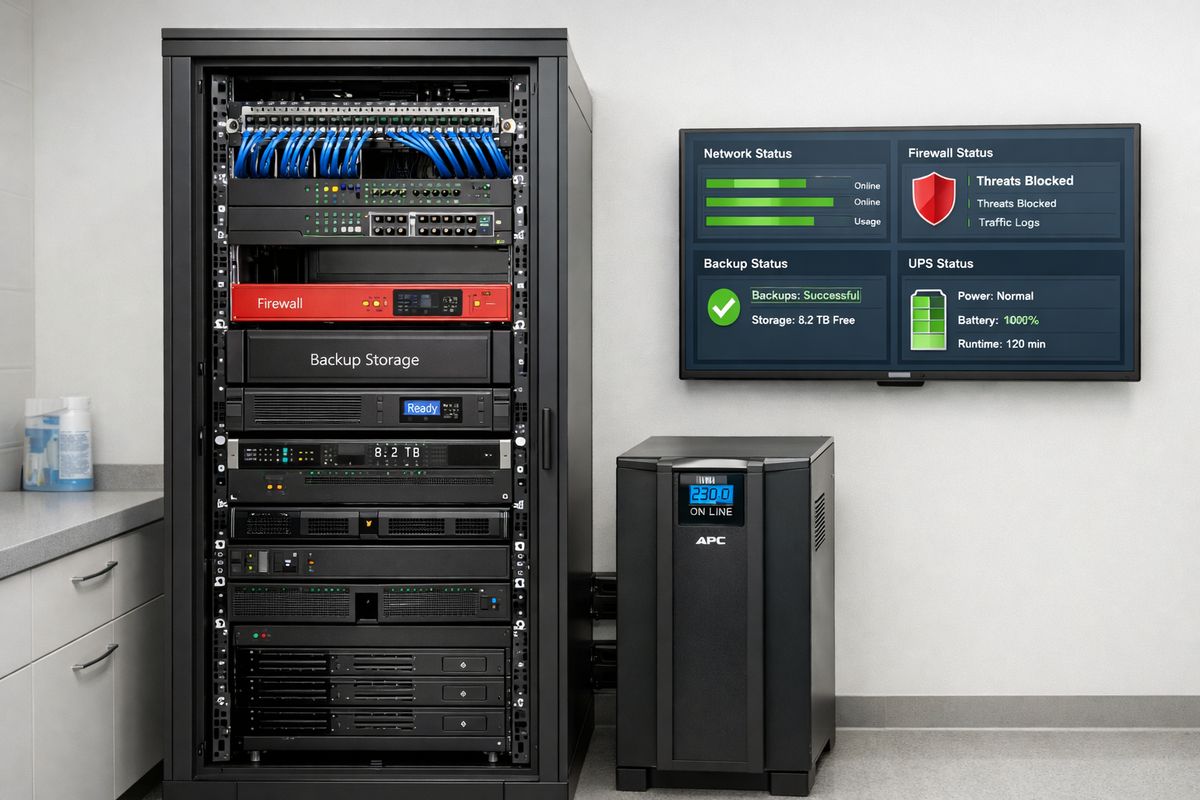
What strong healthcare IT support looks like in practice
A 2026 ASHE and Health Facilities Management survey found that only 34% of respondents said security officials coordinate with IT teams on cybersecurity-related physical environment measures. That gap is a warning. Healthcare-ready IT is not just technical coverage. It is coordinated operational support across systems, spaces, people, and vendors.
The buyer’s question is not “Does this provider do IT?” The better question is “Can this provider support a healthcare operation without creating friction?”
24/7 Monitoring, tiered support, and clear escalation
The 2026 ASHE survey also showed that cybersecurity planning often starts too late, after infrastructure choices are already in motion. The same problem shows up in support. When escalation paths are vague, routine issues become outages.
The move that works is a tiered support model with proactive monitoring and documented escalation. Routine tickets should not block urgent incidents. Imaging connectivity issues, after-hours medication access problems, and network outages need a fast lane with named responsibility.
Here’s how to use it: require defined response categories and an escalation process that includes both technical and vendor contacts.
Remote and onsite service that fits clinical workflows
A 2024 Technavio market report identified hospitals and clinics as the largest revenue segment in healthcare services. That matters because these settings depend on speed and minimal disruption. Remote support solves many issues faster, especially for account lockouts, software errors, and configuration fixes. But hardware failures, network closet work, cabling issues, printer replacements, and exam room device problems still require onsite service.
What this means in practice is that support must fit the care environment, not the other way around. In a busy clinic or imaging center, service windows, technician conduct, and disruption control matter almost as much as technical skill.
Vendor management and technology coordination
A 2026 ASHE survey highlighted how disconnected planning leaves organizations exposed when building systems, clinical devices, and IT environments are not managed together. The same principle applies at the practice level. EHR vendors, imaging platforms, telecom providers, Microsoft 365, firewall tools, and line-of-business applications all intersect.
The move that works is single-point coordination. One accountable IT partner should own communication across vendors, track issues to resolution, and keep documentation current. That cuts downtime and eliminates the endless handoff problem where every vendor blames another.
The infrastructure services that keep a practice running
A 2026 Persistence forecast found that cloud deployment is expected to hold about 29% of healthcare IT technology share, with cloud and AI-driven operations leading future growth. Behind the scenes, infrastructure is where reliability is built or lost.
What this means in practice is that practices should judge infrastructure services by resilience, access control, and recovery speed.
Cloud hosting, migration, and secure access
HG Insights identifies cloud IaaS as one of the top healthcare technology trend categories. Cloud services are no longer just about moving files off a server. They now support email, productivity, secure file access, identity management, hosted applications, and location-independent operations.
The move that works is controlled cloud adoption with identity protections from the start. That means planning migrations carefully, reducing local server dependence where it makes sense, and standardizing secure remote access for approved staff and devices.
For multi-site practices and distributed teams, cloud management is often the difference between consistent operations and fragmented access.
Backup, disaster recovery, and business continuity
A 2024 Persistence-backed survey found both high cybersecurity incident rates and strong concern about implementation cost. Backup is where those pressures collide. Cheap backup looks fine until recovery fails.
Here’s how to use it: buy backup as a recovery service, not as a storage product. Practices need verified backups, recovery time objectives, ransomware-aware restoration, and documented continuity procedures for phones, scheduling, chart access, and billing. The buying question is not “Are backups running?” It is “How fast can operations be restored after a real outage?”
Network performance for multi-site and high-uptime environments
A 2026 ASHE survey included warnings from facilities and security leaders that many connected systems enter the network without enough oversight. That matters even in smaller environments. Phones, printers, wireless access points, cameras, badge systems, diagnostic devices, and telehealth traffic all compete for bandwidth and security attention.
The move that works is managed network performance with segmentation, secure Wi-Fi, firewall oversight, redundancy planning, and visibility into connected assets. Imaging centers and senior care facilities feel this first because latency and downtime hit throughput immediately.
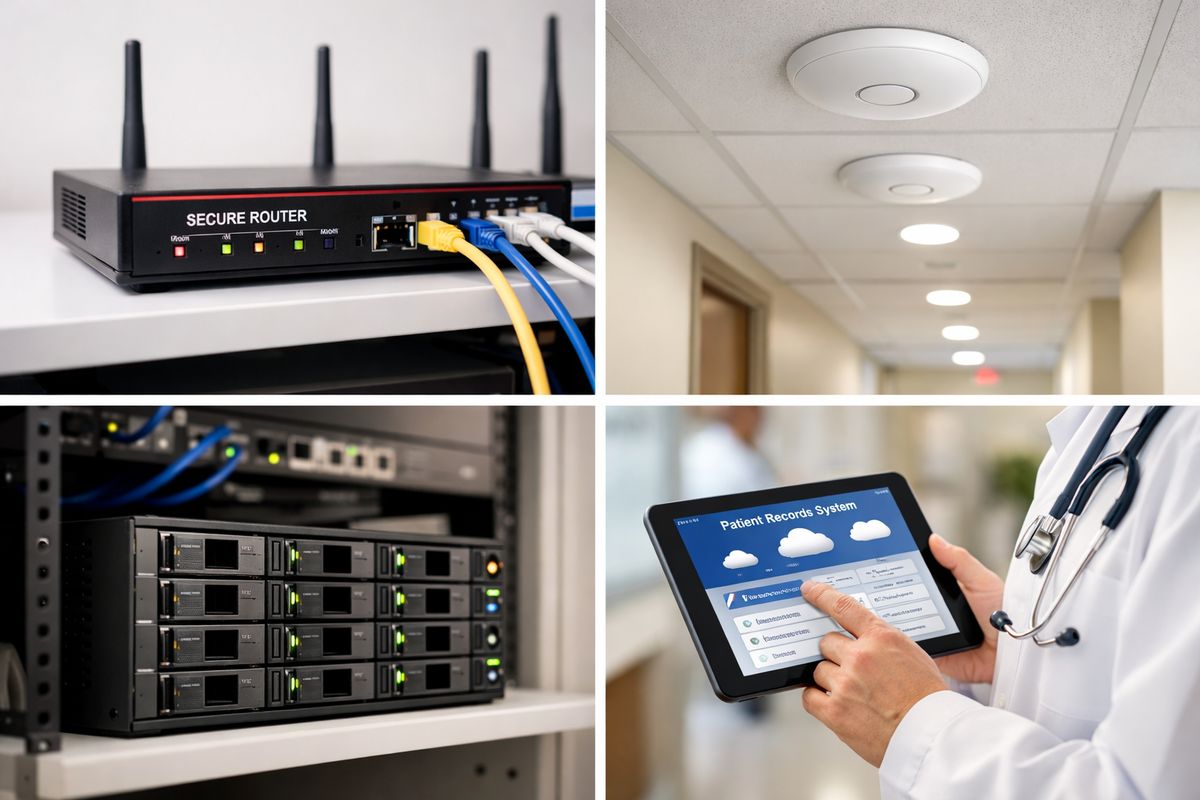
The specialized services that improve care delivery and efficiency
A 2025 Persistence report found that interoperability standards such as FHIR and HL7 are being implemented in over 30 countries, while virtual care services are now offered by more than 90% of providers. That is where healthcare IT services shift from maintenance to advantage.
Here’s the practical takeaway: specialized services reduce manual work, speed decision-making, and create room for growth.
Interoperability and system integration
The Persistence data on FHIR and HL7 reflects a larger truth: disconnected systems waste time everywhere. Practices lose hours to duplicate data entry, manual fax handling, incomplete records, and billing mismatches.
The move that works is interface planning before adding another platform. Lab feeds, imaging results, patient messaging tools, billing software, and EHR workflows should connect in a deliberate way. Shared data reduces rework. It also reduces avoidable mistakes.
Telehealth and remote care enablement
A 2024 Technavio report points to telemedicine adoption as a major market opportunity. Telehealth is now standard infrastructure for many specialties, follow-ups, behavioral health interactions, and distributed care models.
What this means in practice is that telehealth support must cover more than the video platform. Scheduling integration, device readiness, microphone and camera support, secure connectivity, user permissions, and patient-friendly workflows all matter. In senior care and multi-location operations, remote access standards matter even more.
Reporting, analytics, and business intelligence
HG Insights identifies business intelligence as one of the top high-value healthcare IT categories. Data only helps when it turns into visible action. Dashboards for scheduling lag, no-show rates, payer mix, claims bottlenecks, room utilization, staffing load, and referral patterns give management teams leverage over performance.
Here’s how to use it: start with a small set of operational metrics tied directly to revenue cycle, staffing, or patient access. Analytics should answer management questions, not produce more reports that nobody uses.
How to choose the right healthcare IT service model
A 2026 Persistence forecast shows the healthcare IT market growing rapidly because support, integration, and managed services are increasingly necessary. The right model depends on staffing reality, compliance demands, and how much accountability the organization wants outside internal operations.
The move that works is matching the service model to operational complexity, not just budget preference.
Fully managed IT vs. co-managed IT
A 2024 HG Insights review makes clear that services dominate spend because systems require active support every day. Fully managed IT fits practices with no internal IT bench strength. Co-managed IT fits organizations with an administrator, operations lead, or internal technical resource that needs backup, tooling, and specialized healthcare coverage.
What this means in practice is simple. If internal staff already handle vendors, devices, and user issues but lack security depth or after-hours coverage, co-managed support is efficient. If IT work is fragmented across office managers and outside contractors, fully managed service is the cleaner fix.
Project-based support vs. ongoing managed services
A 2024 survey found high rates of cybersecurity incidents across healthcare providers. That fact alone makes the trade-off obvious. Project work solves migrations, upgrades, and one-time rollouts. It does not provide daily monitoring, account control, backup validation, or threat response.
The move that works is using projects for change and managed services for stability. In regulated healthcare environments, ongoing service is the baseline. Project-only support leaves a gap between major initiatives, and that gap is where risk builds.
Local responsiveness and industry experience
A 2024 Technavio report says North America growth will lead the broader market. For organizations in Lafayette and surrounding areas, local responsiveness still matters because healthcare operations are physical as well as digital.
Here’s how to use it: prioritize providers that understand healthcare workflows, can support onsite needs quickly, and have experience in environments like physician practices, imaging operations, and senior care. Industry experience shortens diagnosis time. Local presence shortens recovery time.
Budget priorities and the hidden costs of cheap IT
A 2024 Persistence-backed survey found that over 55% of community hospitals cite upfront cost as a major barrier to digital adoption. Budget pressure is real. But cheap IT usually fails in the exact places healthcare organizations cannot afford failure: security, backup, support speed, and documentation.
What this means in practice is that budget discipline should focus on service sequence, not service avoidance.
What to prioritize first on a limited budget
HG Insights reports that small organizations make up 77% of healthcare IT buyers. That matters because most practices are not building enterprise IT departments. The move that works on a limited budget is prioritizing security management first, then verified backup and recovery, then EHR support, then dependable help desk coverage.
That order protects operations. Security reduces exposure, backup reduces outage damage, EHR support protects the system at the center of work, and help desk service protects daily productivity.
Where low-cost IT services usually fail
A 2026 ASHE survey found that coordination gaps across infrastructure and cybersecurity remain common. Cheap IT usually reproduces that same problem at a smaller scale. Documentation is weak, vendor ownership is vague, backup testing is skipped, and support stays reactive.
The catch is that these failures stay hidden until a breach, outage, audit issue, or failed update exposes them. By then, the cost is much higher than the savings ever were.
Common mistakes practices make when buying healthcare IT services
A 2026 hospital construction survey published by Health Facilities Management showed that operational teams are still left out of cybersecurity-related decisions too often. Buying mistakes usually come from the same mindset: technology is treated as a side function instead of an operating system for the practice.
Here’s how to avoid that trap.
Treating compliance as paperwork instead of operations
The ASHE survey found that only half of respondents said staff receive training on security protocols for new or renovated spaces. Policies alone do not create compliance. Controls do. Access management, encryption, audit logging, backup verification, monitoring, and user training are what make policy real.
The move that works is buying services that turn compliance into routine operations.
Buying tools without integration planning
A 2025 Persistence report shows global growth in interoperability because connected systems matter more every year. Buying another app without interface planning usually adds friction, not efficiency. Staff end up entering the same data twice, chasing records, or working around broken workflows.
The move that works is demanding integration planning before deployment.
Waiting for a crisis before standardizing IT
Michael Lauer of BJC Health System, cited in a 2026 HFM report, warned that adding security and infrastructure measures later is more expensive than building them in early. The same is true across practice IT. Reactive upgrades cost more because they happen during stress, not on a plan.
What this means in practice is direct: standardization should happen before the outage, not after it.
The best healthcare IT service priorities by practice type
A 2024 Technavio report found that hospitals and clinics hold the largest market share, while adult care continues to expand rapidly. Service priorities should reflect operational environment, not generic best practices.
Physician practices and multi-provider clinics
A 2025 Persistence report confirms that EHR use and virtual care are now standard across healthcare. For physician practices and multi-provider clinics, the service stack should center on EHR support, rapid help desk response, secure email, cloud productivity tools, and verified backup. Front-office continuity matters just as much as clinical uptime because scheduling, intake, referrals, and billing all drive revenue.
Imaging centers and diagnostic environments
HG Insights identifies storage management as a top healthcare IT trend category. That fits imaging operations perfectly. Imaging centers need strong network performance, dependable storage, vendor coordination, uptime discipline, and solid integration between PACS, modality systems, and practice applications. In this environment, technical delay quickly becomes patient delay.
Senior care and distributed care teams
Persistence projects home healthcare as one of the fastest-growing segments. Senior care and distributed care teams need secure remote access, mobile device support, telehealth readiness, user training, and continuity planning across locations. The move that works is designing for mobility from the start instead of treating remote care as an exception.
A simple next step to take this week
A 2025 HG Insights market view and the broader healthcare research point to the same conclusion: the best-run practices treat IT services as operating infrastructure, not occasional support. The clearest next step this week is a gap review. Confirm whether current coverage includes active security management, tested backups, EHR support, cloud administration, help desk response, and vendor coordination.
That one review usually reveals the real issue. Not a lack of tools, but a lack of complete coverage.